

Commentary
A conflict launched in the name of American security is producing the opposite effect.
Sarah Yerkes
{
  "authors": [
    "Damien Ma"
  ],
  "type": "commentary",
  "blog": "Emissary",
  "centerAffiliationAll": "",
  "centers": [
    "Carnegie Endowment for International Peace"
  ],
  "englishNewsletterAll": "",
  "nonEnglishNewsletterAll": "",
  "programAffiliation": "",
  "regions": [
    "China"
  ],
  "topics": [
    "Economy",
    "Technology",
    "Domestic Politics"
  ]
}

Xi arrives at the Great Hall of the People on March 4, 2026, in Beijing. (Photo by Kevin Frayer/Getty Images)
While the Strait of Hormuz crisis roiled the global economy, Chinese President Xi Jinping was putting his imprimatur on China’s economic and social blueprint. On March 12, the National People’s Congress approved China’s fifteenth Five-Year Plan, which covers this year through 2030. Central to the plan—Xi’s third as president—is the elevation of “high quality” development that approximates a “Xi doctrine” on the economy. The term is pervasive in the latest plan, appearing at least 50 percent more than in the previous iteration. It has clearly become an organizing principle associated with Xi himself, making its significance as much political as it is economic.
In many ways like a large corporation, China operates on five-year planning cycles that also overlap with its five-year political cycles. The plans are painstakingly put together across multiple government agencies over at least two years and reflect the top leadership’s political mandate. Once the plan is out, China aims to stick with it and marshals the entire bureaucracy and provinces to execute, with the intent of minimizing major corrections within the timeframe. Though the plan is sufficiently flexible to allow for adaptation to local conditions, every level of government is expected to execute within the parameters of the plan—their performance and political prospects depend on it.
Xi has attempted to reset the Chinese economy for years now with mixed success. First, he took the controversial step to water down the importance of the GDP target in the fourteenth Five-Year Plan, then he forced a rapid correction in the property market a couple years later that surprised many. Shortly after, he followed with a crackdown on China’s big tech companies that spooked investors. Throughout his tenure so far, Xi has repeatedly withheld major stimulus—to the frustration of markets.
Of course, resetting the Chinese economy isn’t simply a matter of having optimal policies. China has plenty of policies that are diligently read and analyzed by many. But the gap between what’s in a plan (what Beijing says) and what actually gets realized (what the rest of China does) is a political economy problem, not a policy one.
That political economy problem, in Xi’s view, rested with “GDP worship” as an organizing principle—something that has frustrated him for a long time, according to his own speeches. GDP growth wasn’t simply economic in nature; it was a political performance metric that the entire system of politicians was measured against. It was a clear and singular number that served as the holy key performance indicator: If GDP did well, then you, the local cadre, did well.
But that metric was subject to manipulation. Pumping up GDP often required mindless maximization of capacity and investment, whether it produced economic value or not. For instance, China dealt with “ghost cities” in the 2010s, which many took to be a symbol of excess in the property market. And at Chinese scale, the dogged pursuit of that GDP-centric model has led to considerable waste and local debt. Xi does not like either.
So what is the new “high quality” organizing principle, since it isn’t about mere product quality? A simple heuristic in understanding the shift is that the target that matters much more now is total factor productivity, or TFP, rather than GDP. In economic speak, this is the difference between intensive growth and extensive growth.
Extensive growth basically depends on deploying more workers, more machines, and more capital to generate growth. In Xi’s rendering, this is quantity-driven growth. It eventually reaches diminishing returns because there’s only so much that can be deployed before it no longer makes rational economic sense.
But pursuing that type of growth can still make political sense because it enhances prospects for politicians and bureaucrats. A new road can be built, and that will add to GDP. But if few people or businesses use it, then it doesn’t really generate much economic value. Bolstering local GDP, however, might get the bureaucrat a promotion, so the political incentive is strong to stick with that approach.
That approach, combined with Chinese scale, has eluded conventional wisdom on how long extensive growth can last—typically, that type of growth peters out when an economy starts to run out of low-cost labor (known as the Lewis turning point). At that juncture, labor becomes more expensive, so to maintain economic growth, countries attempt to make the transition to intensive growth. This rests on efficient deployment of finite resources, focusing on productivity gains per worker and the continuous improvement and generation of new technologies, processes, knowledge, and organizational efficiencies—in short, TFP-driven growth.
In Xi’s rendering, that is high-quality development. Rather than chasing GDP, the political mandate now is that cadres need to demonstrate how their local economic plans pass the high-quality litmus test. And the brave new world of quality over quantity has several significant implications.
For one, lower growth targets will likely be a norm rather than a surprise. Moreover, it implies China is likely at the beginning of the end of its deployment super cycle—a massive capacity expansion period that spanned five consecutive five-year plans from 2001 to 2025. This was the period that built the bullet trains, the modern cyberpunk cities, and electric vehicles that many have rightly come to marvel as a testament to China’s technological prowess and economic success.
The next period of growth will emphasize value creation over volume generation for Chinese companies. This is a necessary precondition to avoid the persistent curse of “involution” that induces ferocious competition, destroys corporate value, and squeezes margins, evident in Chinese products ranging from EVs and solar to hydrogen electrolyzers.
This matters tremendously because involution comes at the expense of innovation. The private sector often leads in novel innovations and excels at inventing frontier technologies, but that requires significant and sustained investment in R&D. It is much easier to do so if companies have profits to plow back into innovation-related activities. Rather than engaging in the exhausting rat race just to barely survive in a Darwinian market, profitable Chinese companies can better thrive in the global innovation race.
That’s precisely aligned with Xi’s central priority of technological self-reliance, where Chinese companies should lead the way on “0 to 1 innovation” that creates entirely new technologies that didn’t exist before, much like how the United States invented the internet and the microprocessor.
Whether this pivot can happen within the five-year timeline is far from assured. Xi knows as well as anyone that turning the ultra-large container vessel that is the Chinese economy is not for the faint of heart. Even as one of the most powerful Chinese leaders in recent memory, Xi needed more than a decade just to cement a new organizing principle that is the antithesis of quantity. Now comes the really hard part: execution.

Director, Carnegie China; Maurice R. Greenberg Director’s Chair
Damien Ma is the director of Carnegie China, an East Asia-based research center with its office in Singapore. For two decades, Damien has worked at the intersection of markets, policy, and global affairs, becoming a leading voice on China’s ascendance and U.S.-China dynamics, the most consequential bilateral relationship of the century.
Carnegie does not take institutional positions on public policy issues; the views represented herein are those of the author(s) and do not necessarily reflect the views of Carnegie, its staff, or its trustees.
A conflict launched in the name of American security is producing the opposite effect.

Sarah Yerkes
Restoring competence and trust to the anemic, neglected disaster recovery agency is a matter of national security.


Sarah Labowitz, Debbra Goh
Although the IAA often differs from the IRA, European policymakers can still take note of the U.S. act’s shortcomings.

Milo McBride
Going to war was the U.S. president’s decision, for which he alone is responsible.


Daniel C. Kurtzer, Aaron David Miller
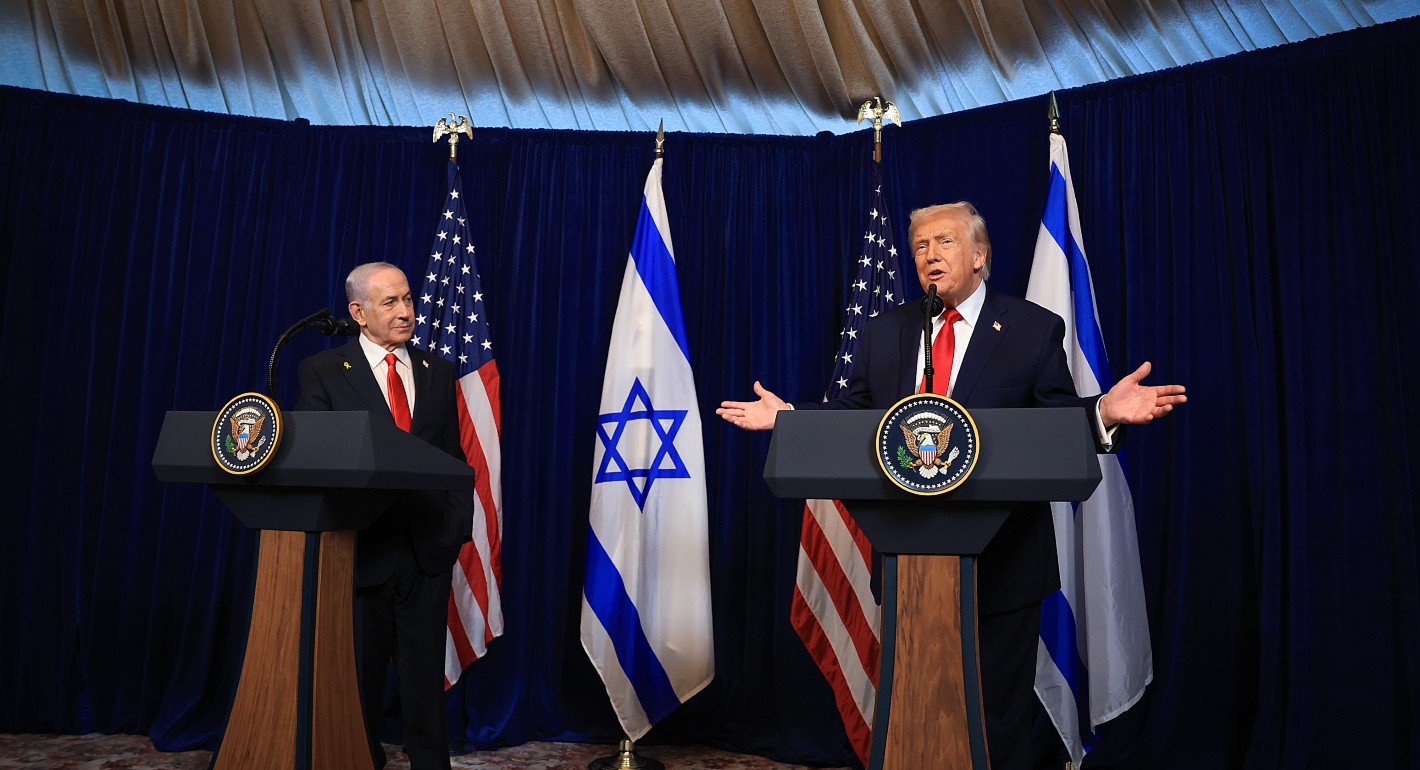
The cracks between Trump and Netanyahu have become more pronounced, particularly over energy and leadership targets.

Eric Lob