

Paper
Leonardo Martinez-Diaz, Noah Gordon, Milo McBride
{
  "authors": [
    "Noah Gordon"
  ],
  "type": "commentary",
  "blog": "Emissary",
  "centerAffiliationAll": "dc",
  "centers": [
    "Carnegie Endowment for International Peace"
  ],
  "englishNewsletterAll": "",
  "nonEnglishNewsletterAll": "",
  "primaryCenter": "Carnegie Endowment for International Peace",
  "programAffiliation": "SCP",
  "programs": [
    "Sustainability, Climate, and Geopolitics"
  ],
  "projects": [],
  "regions": [],
  "topics": [
    "Energy",
    "Climate Change"
  ]
}
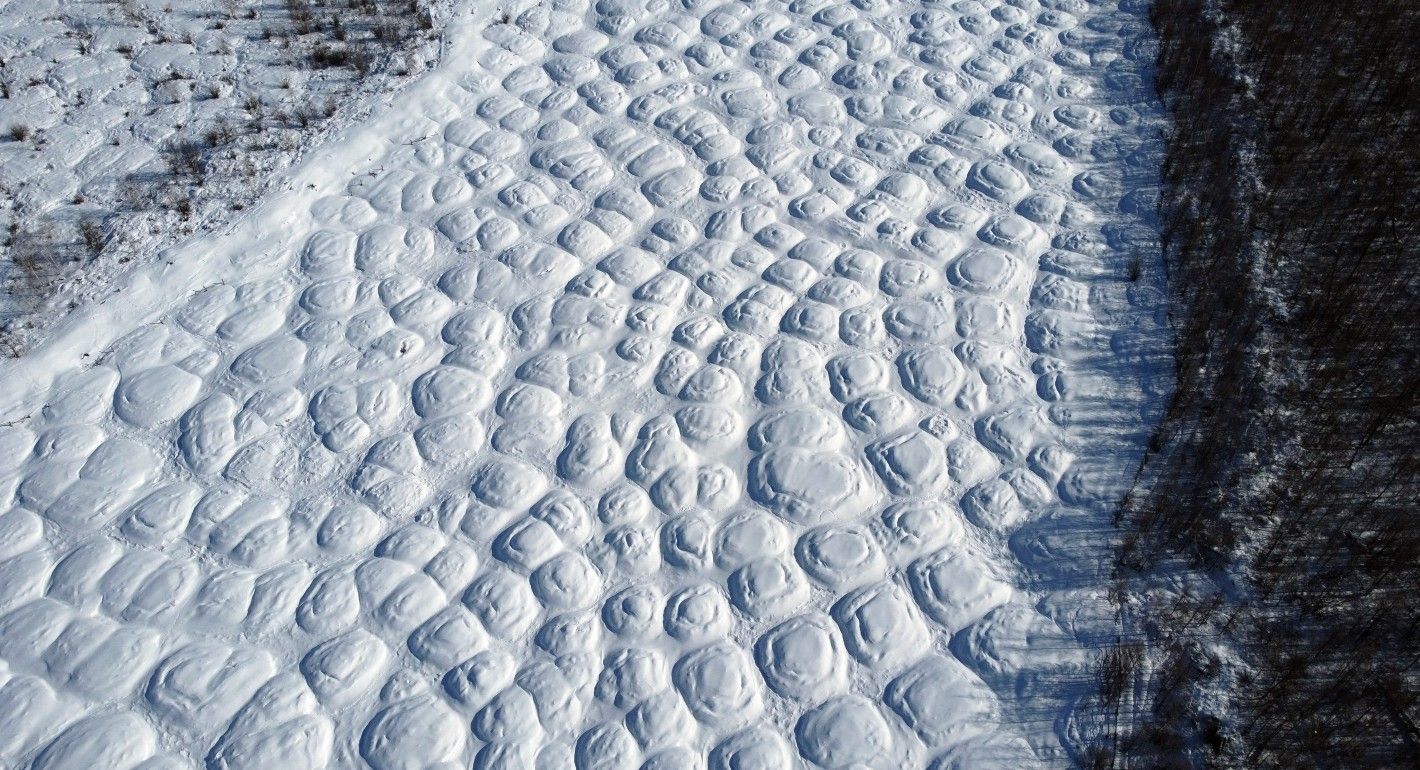
Thawing permafrost in Yakutsk, Russia, on March 29, 2025. (Photo by Ekaterina Anisimova/AFP via Getty Images)
The cessation and mass removal of emissions would not simply turn back the clock.
Humankind has a tremendous ability to affect the Earth’s climate, and that contribution is commonly assessed by a single metric: annual greenhouse gas emissions. But what actually determines how much excess heat stays in the Earth system is the concentration of greenhouse gas, particularly carbon dioxide, in the atmosphere. In 2024, this number reached 442 parts per million (ppm). That was an increase of 3.4 ppm, the biggest jump since the beginning of yearly measurement.
The reason for the record rise last year was not just the slow and steady climb of emissions from burning fossil fuels (37.4 billion tonnes of CO2 in 2024). It’s that the land and the oceans failed last year to absorb as much carbon as usual. This is a warning sign for policymakers that it’s dangerous to assume that humans have their hands on a global thermostat.
Since 1850, the land and oceans together have absorbed about half of the carbon emitted by human activity—31 percent and 26 percent, respectively, with both taking up more carbon in absolute terms each year as human emissions have grown. These natural carbon sinks are indispensable for finding a way out of the climate crisis. In the famous climate metaphor where the atmosphere is a bathtub and human emissions are the water coming out of the tap, the natural sinks are the opening in an otherwise blocked drain. In the mental model of most climate-concerned policymakers, the challenge is simply to close the tap.
Scientists see a further cause for concern: The drain is becoming more blocked. In other words, a larger and larger share of what humans emit is staying in the atmosphere. The 2023 IPCC report notes that “in scenarios with increasing CO2 emissions, the land and ocean carbon sinks are projected to be less effective at slowing the accumulation of CO2 in the atmosphere.” But some ecosystem responses to warming—such as wildfires and melting permafrost—are “not yet fully included in climate models,” the report notes. Recent data show that thawing permafrost emissions equal Japan’s greenhouse gas emissions, and emissions from Canadian wildfires alone in 2023 were even higher than that, making these emissions a rather significant omission.
The World Meteorological Organization (WMO) notes that the jump in CO2 concentrations in 2024 largely had temporary causes: 2023 and 2024 were years with an El Niño weather pattern, when global temperatures are generally higher and some regions suffer droughts. Climate impacts, however, threaten to turn temporary drivers into structural problems. The WMO registers “significant concern” that land and ocean sinks are “becoming less effective, which will increase the fraction of anthropogenic CO2 that stays in the atmosphere, thereby accelerating global warming.” So far the trend has been moderate: Although in 1970 it took 24 gigatons of anthropogenic emissions to raise the atmospheric concentration by 1 part per million, it now takes 19 gigatons. But the direction of travel is clear. As the oceans warm, they lose some of their ability to absorb CO2, and global heating makes plants more prone to dry out or burst into flames. The land sink was especially weak in 2023 due in large part to the aforementioned forest fires.
If human-generated emissions were falling rapidly, the likely weakening of natural sinks would be a manageable problem. That is not the situation that we find ourselves in. Anthropogenic emissions continue to grow, and climate models increasingly plan to overshoot agreed-upon temperature thresholds (such as 2 degrees Celsius). The combination of rising emissions and weakening carbon sinks is leading global temperatures to increase at about 0.27 C per decade, faster than the 0.2 C per decade warming rate of the 1990s and 2000s. An “acceleration,” scientists fret.
Some want to use negative emissions technologies, such as machines that suck carbon from the air and store it underground, to return the planet to a prior and safer state. (Think of punching a new hole in the bottom of the metaphorical bathtub.) But if such machines did exist at scale, they would also face challenges related to the natural sinks. If humans were withdrawing more carbon from the atmosphere than they were adding (negative emissions), the natural sinks would weaken further—and perhaps even become net sources of carbon. This is because the ocean would seek to release CO2 in order to reach a new equilibrium with the atmosphere. Withdrawing a unit of carbon dioxide from the atmosphere would reduce atmospheric concentrations by less than one unit because natural sinks would “outgas” more into the atmosphere, adding to the already mammoth task.
What this means is that humans, for all the effect they have on the Earth’s climate, do not control it. The cessation and mass removal of emissions does not simply turn back the clock. When a natural system passes a certain threshold—a tipping point—it can fall over and collapse, even if the force that knocked it over is no longer present. The technical term for this lag between effect and cause is hysteresis. Carbon sinks may be in this state. The newly released Global Tipping Points Report notes that critical sinks in the Arctic tundra and Northern boreal forests “are now shifting to become carbon sources.” Other systems, such as the Atlantic Meridional Overturning Circulation that keeps Europe’s climate mild, are vulnerable to the same fate.
The top energy analysts expect anthropogenic emissions to peak this decade. This would be a tremendous achievement and the beginning of a true energy transition. We finally would be getting a grip on the drivers of climate change that we control. Some drivers of this crisis, though, are out of our hands. And the line that really matters keeps going up, faster and faster.

Fellow, Sustainability, Climate, and Geopolitics Program and Fellow, Europe Program
Noah J. Gordon is a fellow in the Sustainability, Climate, and Geopolitics Program at the Carnegie Endowment for International Peace in Washington, DC.
Recent Work


Leonardo Martinez-Diaz, Noah Gordon, Milo McBride
Noah Gordon, Daevan Mangalmurti
Carnegie does not take institutional positions on public policy issues; the views represented herein are those of the author(s) and do not necessarily reflect the views of Carnegie, its staff, or its trustees.
Former agency officials discuss how reforms could reshape the agency and how states should prepare.

Sarah Labowitz
Without addressing the worsening issue’s root causes, any mitigation efforts will likely fall short. States in similar situations should take note.

Eric Lob
Washington’s opposition to the IMO’s Net-Zero Framework jeopardizes a landmark agreement and hands rivals the chance to lead the clean shipping transition.

Narayan Subramanian
The push to reuse spent nuclear fuel ignores hard-learned lessons.
Sueli Gwiazdowski
States are feeling the pain.

Jennifer DeCesaro, Sarah Labowitz